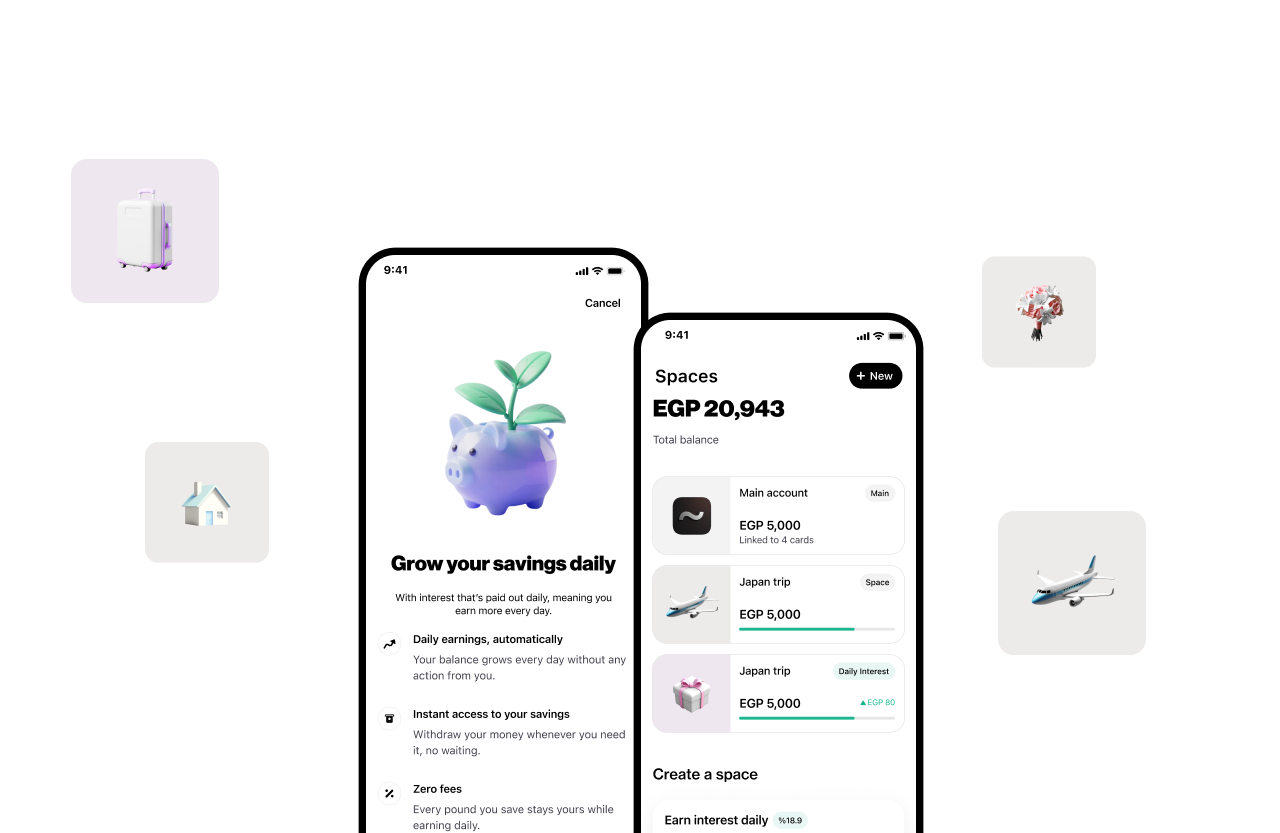
Money sitting still,
a missed opportunity
Telda Spaces originally served as a money segregation tool — users could set aside funds for specific goals like travel, emergencies, or major purchases. But the money just sat there. It didn't grow.
Users had already parked EGP 95M across Spaces, while the feature remained a segregation tool with no growth mechanism. This was a missed opportunity for acquisition, retention, and value creation for both users and the business.
41% of Space users had empty Spaces — they created Spaces but never funded them. The segregation-only model wasn't compelling enough to drive deposits. Adding a growth incentive could activate this dormant user base.
North Star
Transform Spaces from a passive money bucket into a liquid savings experience that helps users grow idle balances without sacrificing simplicity or access.
How do we layer a complex financial product (fund-based daily returns) on top of a simple savings feature without adding friction, confusion, or breaking the mental model users already have?
Understanding
the landscape
I conducted a detailed competitive audit of every relevant player in the Egyptian market plus international benchmarks. The goal was to understand how others handle the same fund mechanics and where they create friction.
Egyptian Market: Fawry, Halan, Thndr
| Provider | Buying Experience | Selling Experience | Key Friction |
|---|---|---|---|
| Fawry | 1 business day hold. Interest reflects after 48 hours. | Instant on card (capped at 300K). Calculated on T-1 price with fraction rounding. | Long hold periods Confusing fraction logic |
| Halan | 48-hour hold. Interest after 48 hours. Cut-off at 10 AM. | Instant on card (30K/day cap). Bank: 1–3 days. | Longest hold in market Daily withdrawal cap |
| Thndr | No hold. Cut-off at 6 AM. Must stay until cycle. | Instant to investment wallet. Bank transfer ~20 min. | Indirect withdrawal path Requires wallet step |
No Egyptian competitor offered all three: no hold period + instant withdrawal to card + zero fees. This became our core differentiator.
International Benchmarks
I studied how international neobanks handle the savings-within-spaces model:
Savings is treated as a state of money, not a separate place. Spaces have clear purposes and can be linked to cards. Savings is just one type of Space.
Groups financial products into Spaces organized around financial goals and life outcomes — not just accounts. Includes Save & Invest, Borrow, and Pensions tabs.
Uses parallel accounts (Cash, Savings, Invest, Crypto). Savings isn't merged into the main abstraction. They visually merge via a Total Wealth view.
Pots as the core abstraction. Each pot has a job (Rent, Bills, Holiday). Savings is simply a pot that earns interest — not a separate mental model.
Monzo's approach was the strongest signal for our direction: don't create a new product category, just make the existing one smarter.
Six distinct
savings behaviors
Through internal data analysis and qualitative research, I identified six distinct user segments for Spaces:
Saving toward specific milestones like a car, wedding, or trip. Most likely to use Space goals and deadlines.
Using Spaces to allocate monthly spending across categories. High-frequency, low-balance behavior.
A distinctly Egyptian savings pattern: rotating group contributions. Think in cycles, not goals.
Want to preserve purchasing power. Interested in gold or fixed returns rather than cash sitting idle.
Move money between Spaces monthly. Disciplined but doing everything manually.
Want multiple Spaces, automation, and more control. Power users who would adopt Daily Saver early.
Segments 1, 4, and 6 — Goal Savers, Value Protectors, and Advanced Users — were our primary targets. They already had the intent to save, and the Daily Saver Space directly addressed their unmet need for growth.
Four rules that
guided every decision
Savings, not investing
The product is powered by a fund, but it must feel like a savings account. No jargon, no unit prices, no certificate talk. Users see balances and returns in EGP.
Zero-friction layering
Daily Saver is an addition to Spaces, not a replacement. The existing Space creation flow stays intact. Users choose their Space type during creation.
Invisible complexity
Fund mechanics (cut-off times, fraction handling, batch execution, T-1 pricing) are real but must be absorbed by the system, not pushed to the user.
Transparency on demand
While we hide complexity by default, users who want to understand how it works can access clear educational content. No surprises.
Where Daily Saver
lives in Spaces
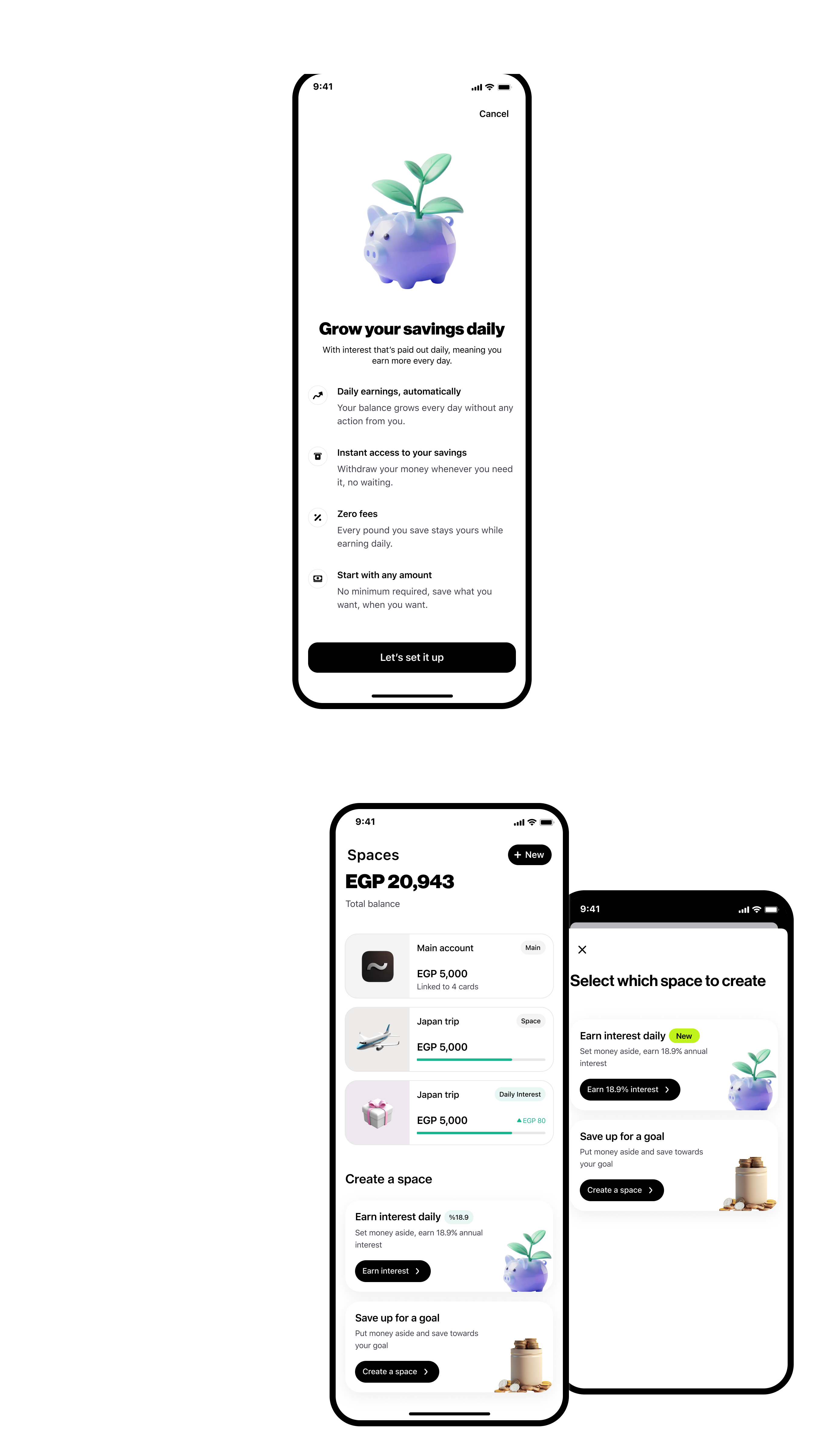
The key IA decision was where the Daily Saver Space lives within the existing Spaces structure. Rather than creating a separate section, Daily Saver is a new Space type within the existing creation flow.
The Spaces hub shows all Spaces together — regular and Daily Saver — with visual differentiation through a "Daily Interest" badge and earned returns displayed in green.
From onboarding
to daily returns
Every flow was designed to keep the complex fund mechanics invisible while delivering a simple, confidence-building experience.
Product Framing
One of the most important product decisions was to keep the new proposition inside Spaces rather than launching it as a separate product.
Save up for a goal
Traditional Space — segregate money for specific purposes
Earn interest daily
Daily Saver Space — same mental model, now with growth
Onboarding: Contract Without Ceremony
Users must be contractually onboarded to the fund product. Three scenarios exist — but the design decision was to never show a processing state. The contract is either signed or not. No ambiguity, no waiting screens, no "pending" status.
Three Onboarding Paths
- New Telda customers sign the Space Contract as part of their card KYC flow — no extra step
- Existing customers who haven't done trading KYC complete a lightweight digital contract signing
- Trading-onboarded customers skip everything — they're already cleared
The Intro Screen: Setting Expectations
When a user first encounters the Daily Saver Space, they see a clear value proposition screen. Each message was crafted to directly counter the friction points found in competitors.
Space Creation: Familiar Patterns, New Power
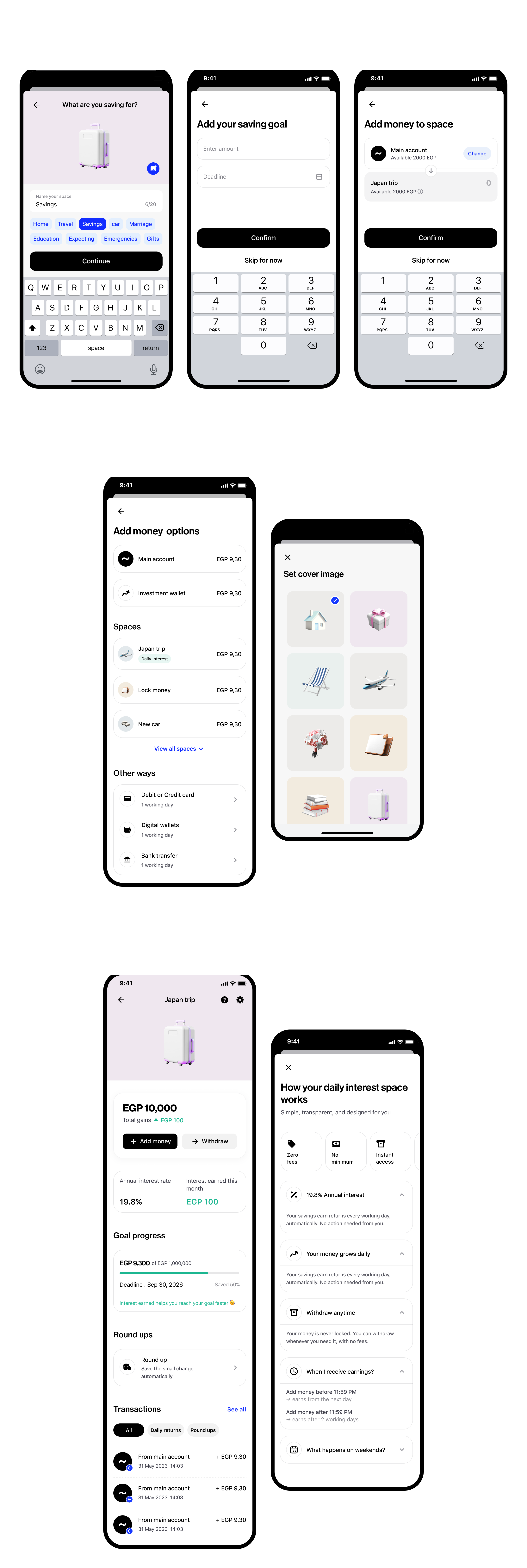
The creation flow follows the same pattern as regular Spaces: name your space, pick a cover image, optionally set a goal and deadline. Then add money. The only difference is what the Space does with the money once it's there.
By keeping the flow identical, we reduce the cognitive load of adopting a new product type. Users don't need to learn a new pattern — they're still creating a space, still assigning money to an intent. The learning curve drops dramatically.
Buying: Instant Balance, Background Execution
When users add money, the experience feels like a simple transfer: select the Space, enter an amount, confirm. Balance updates immediately. Money is never locked or held.
What the system handles silently
- Cut-off timing: Money added before 11:59 PM starts earning the next day. After 11:59 PM, it takes 2 working days.
- Weekend batching: All balances remaining over the weekend are batched and submitted to the fund admin on Sunday.
- Fraction handling: If the amount doesn't add up to a full fund unit, full units are purchased and the remainder is stored. The user never sees this.
Selling: Instant Withdrawal, Deferred Settlement
Withdrawals are instant to the Telda card. This was our single biggest competitive advantage. The user sees: "I withdrew EGP 5,000 and it's on my card now." The system handles the rest.
The complexity underneath
- Pricing: Withdrawals use the last announced certificate price (T-1 on business days, T-2/T-3 on weekends)
- Settlement: The actual fund sale happens in the next execution batch, but users get their money immediately
- Fraction handling: Withdrawals rounded to nearest full unit, checking fraction balance to maximize the payable amount
The Detail View: Growth Made Visible
The Space detail screen is where users see the payoff of their decision. It shows current balance with total gains highlighted in green, annual interest rate, interest earned this month, goal progress, round-ups integration, and filtered transaction history.
Deposit & withdrawal
architecture
Supporting multiple deposit and withdrawal methods was critical for reducing friction and meeting users where their money already lives.
📥 Deposit Methods
- Telda card balancePrimary · Instant
- Bank account transfer
- From trading walletSeamless
- From another Space
- Instapay
- Digital wallets
📤 Withdrawal Methods
- Instant to Telda cardCore differentiator
- Bank account transfer
The "Add money options" screen shows all sources with their balances, making it easy to choose where funds come from. Spaces with the Daily Interest badge are visually distinguished.
Transparency
on demand
The "How your daily interest space works" modal is accessible from the Space detail view. It uses an accordion pattern that lets us be fully transparent without overwhelming the main experience. Information is always one tap away but never in the way.
19.8% Annual interest
Explains how returns are calculated based on the fund's performance, expressed as an annualized rate. Users see this in simple EGP terms — how much their balance earned today, this week, this month.
Your money grows daily
Reassures users that earning is automated. No action required — the balance grows every day the money remains in the Space.
When do I receive earnings?
Explains the before/after 11:59 PM cut-off clearly. Money added before 11:59 PM starts earning the next day. After that, it takes 2 working days. This addresses the most common question without cluttering the deposit flow.
Withdraw anytime
Reinforces liquidity — the key competitive advantage. Your money is never locked. Withdraw to your Telda card instantly, anytime.
What happens on weekends?
Addresses the batching behavior transparently. Balances remaining over the weekend are batched and submitted to the fund admin on Sunday. Users don't lose earnings — the system handles the gap.
What changed —
and why it matters
Spaces helped users separate money
A passive organizational feature. Users created buckets for goals, but money sat idle with no incentive to fund them. 41% of Spaces were empty.
Spaces help users separate and grow money
A stronger money behaviour system — one that sits between budgeting and investing, and feels more aligned with how many users actually think about saving.
What I like about this project is that it changed the role of Spaces without changing its soul. That shift is strategically meaningful — it expands Spaces from a passive organisational feature into a behaviour system that drives both user and business value.
Design Decisions That Defined the Product
Preserved the mental model users already understood. Lowered learning curve dramatically.
The contract is either signed or not. Balances update instantly. No ambiguity, no anxiety.
Each value prop directly addressed a real friction point: hold periods, fees, minimums, complexity.
Accordion FAQ pattern — fully transparent without overwhelming the main experience.